
Top Improving Keywords
Keyword Position Gains highlights tracked keywords whose latest recorded position is better than their previous comparable position.
Overview
Use Position Gains to find recent ranking improvements across the active workspace and search group. The table shows the keyword, domain, search engine, latest position, previous position, movement and ranking URL.
The view is part of Keyword Performance but has its own focused result set. It shows up to ten leading gains from the latest available ranking observations.
Access and data scope
- Position Gains uses the active workspace.
- Results are limited to domains available to the signed-in user.
- Workspace domains are intersected with the user’s accessible domain set.
- The selected search group further narrows the result.
- Each keyword and search engine is evaluated separately.
Changing workspace or search group resets and reloads the Position Gains view when it is open.
Quick start
- Select the relevant workspace and search group.
- Open Position Gains in Keyword Performance.
- Review the largest positive values in Move.
- Compare Latest with Previous and note the engine.
- Select View to open the ranking URL in a new tab.
Understand the table
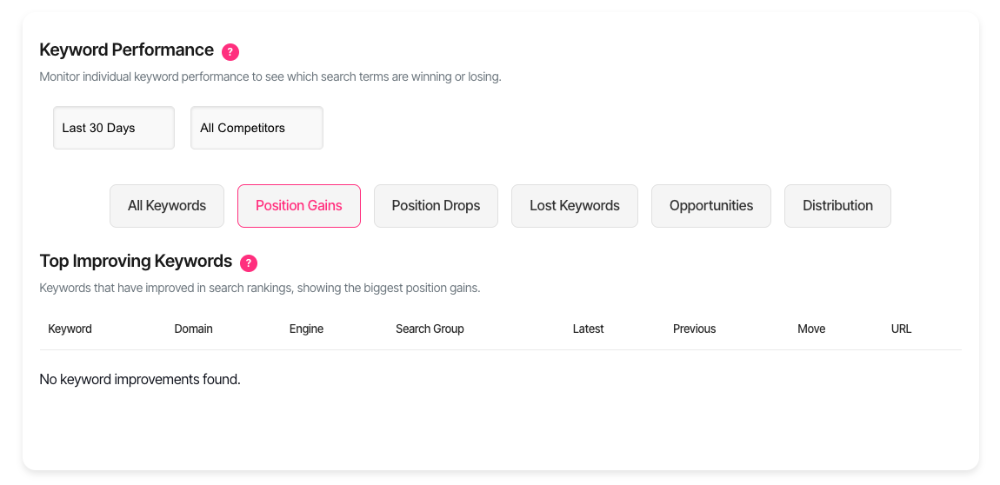
Each row represents one keyword, domain, search group and search engine combination.
- Keyword: The tracked search term.
- Domain: The tracked website.
- Engine: The search engine on which the movement was recorded.
- Search Group: The tracking configuration containing the keyword.
- Latest: The most recent recorded position.
- Previous: The preceding comparable position when available.
- Move: The number of positions gained.
- URL: The latest ranking URL.
Lower position numbers are better. A change from position 18 to position 10 is displayed as a gain of +8.
The same keyword can appear more than once when it is tracked for several engines, domains or search groups.
Interpret movement
Position Gains compares two stored ranking observations. It does not show the full path between them.
- A large positive move indicates a stronger latest position.
- A small positive move indicates incremental improvement.
- Previous: N/A means no preceding comparable ranked observation was available.
- The result does not prove that a page change caused the improvement.
Open the keyword’s full chart in Keyword Performance to review dates, volatility, annotations and competitor movement before drawing a conclusion.
Understand the ranking URL
Select View to open the URL associated with the latest ranking observation.
The ranking URL can change over time. If a different owned URL previously ranked for the same keyword, review Keyword Cannibalisation before assuming the latest URL should be optimised independently.
What should I do next?
- Gain into positions 1–3: Protect the result and avoid unnecessary changes without evidence.
- Gain into positions 4–10: Review the ranking page and monitor whether the first-page improvement holds.
- Gain into positions 11–20: Consider whether focused page improvements can move it onto page one.
- Large one-check gain: Review the full timeline to determine whether it is sustained or volatile.
- Different URL now ranks: Check whether the change is intentional or a multi-URL signal.
- One engine improved but another did not: Investigate each engine separately.
- Need a diagnosis: Open the keyword in Keyword Performance and run Keyword Deep-Dive.
Data timing
The view loads when Position Gains is opened and avoids repeating the same request until the search group changes. Reopen or refresh the page when newer tracking data has arrived but the existing table remains visible.
Position Gains uses stored tracking observations rather than a live search performed when the tab opens.
Troubleshooting
- No position gains found: Confirm the workspace and search group and check whether any keyword improved between comparable observations.
- The same keyword appears more than once: Review the Engine, Domain and Search Group columns; each combination is separate.
- Previous shows N/A: No preceding comparable ranked observation was available.
- Move differs from the full chart: Confirm that both views are using the same search group and latest tracking data.
- A ranking URL is missing or outdated: Open the full keyword history and check the most recent tracking observation.
- The table does not refresh after changing group: Reopen Position Gains or refresh the page.
- View opens an unexpected page: The control uses the URL recorded for the latest ranking observation.
- Error loading keyword improvements: Refresh the page and retry with the same workspace and search group.
Frequently asked questions
Does Position Gains show every improving keyword?
No. The focused table displays up to ten results from the current accessible scope.
Is Move a percentage?
No. It is the number of ranking positions gained between the compared observations.
Does a positive move guarantee more traffic?
No. Traffic impact also depends on the final position, search demand, result layout and click behaviour.
Why is a keyword listed separately for each engine?
Search engines maintain independent result sets, so their movements are evaluated separately.
Does the view explain why the ranking improved?
No. It identifies movement. Use the full keyword chart and Keyword Deep-Dive for investigation.
Can it add an item to the Action Board?
No. This view is read-only.
Does it open Ask Wheremore with analysis context?
No. It does not create a separate analysis report.
Who can see the data?
The view uses the active workspace and only includes domains available to the signed-in user.